


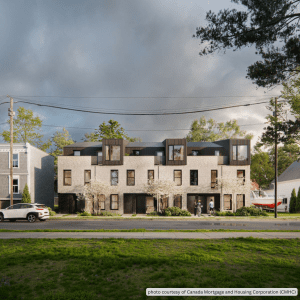
The Housing Design Catalogue is a new initiative introduced by the Canada Mortgage and Housing Corporation (CMHC) to make building new homes easier. It offers free, standardized housing plans for different regions of Canada.
What is the Housing Design Catalogue?
For Atlantic Canada, housing designs were developed by local industry professionals to align with regional building codes, climate zones, and typical construction methods. In Nova Scotia, seven options are available, including accessory dwelling units, fourplexes, sixplexes, and stacked townhouses.
You can browse and download designs directly from the CMHC website.
Incentives to choosing standardized “pre-reviewed” designs
Designing a new residential project takes time and money. The catalogue provides comprehensive architectural drawings at no cost. Many elements, such as cladding, roofing, interior finishes, and other aesthetic details, can be tailored to your site and context. Using a catalogue design may reduce time and cost compared to a fully custom design.
The Municipality has partnered with CMHC to create a combined Development/Building Application form to expediate the permitting and approval process. All combined Development/Building Applications will get priority processing from our internal team.
To further incentivize builders to choose one of the seven “pre-reviewed” housing designs, Council has made the decision to waive all building and development fees associated with as-of-right housing projects that utilized these designs.
Note: Catalogue drawings are “near permit-ready.” They must be adapted to your specific site before permit submission.
How to choose a design for your property
- Zoning & Land Use
Confirm your zoning and applicable Land Use By-law (LUB) requirements. While accessory dwelling units are permitted in most residential areas of Shelburne municipality, developments exceeding two (2) dwellings are not permitted in the Rural Resource (RR) zone . Contact the Economic Development Officer for more information or review:
- Municipality of Shelburne Land Use Map
- Before you settle on a design, contact our Economic Development Officer.
We can help you:
- Understand site servicing needs (driveway/access, and water/sewer lateral connections);
- Review applicable LUB standards (e.g. setbacks, height, lot coverage, parking)
Early confirmation that your project fits zoning, can be serviced, and can meet Building Code requirements helps reduce review time.
- Get Qualified Help
Engage a local contractor and/or a licensed design professional (e.g., architect, engineer) to adapt catalogue drawings to your site and prepare permit-ready documents.
Are the drawings permit-ready?
Not quite. They are near-permit ready. Catalogue drawings must be applied to your exact site conditions (lot size/shape, grades, servicing, coastal, etc.). A qualified professional or experienced local contractor will finalize the package for submission to the Municipality. If in doubt, contact Development or Inspection Services for guidance.
What else must I submit with my permit?
In addition to the architectural plans (floor plans, elevations, sections, details), typical Housing Design Catalogue submissions also contain:
- A complete and submit an application form – complete the fillable PDF linked here, or a hard copy available at the Municipal Office, 414 Woodlawn Drive.
- A site plan showing the proposed building on the lot (dimensions, setbacks, parking, grades/drainage as applicable);
- Site services details (driveway/access, water and sewer lateral locations, sizes, and connections).
Additional documents may be required based on site conditions (e.g., grading/drainage plan, stormwater, energy/Step Code documentation, truss/engineered products, geotechnical, coastal considerations).
How long will permitting take?
Priority Review: Completed combined Development/Building Permit applications that use CMHC Housing Design Catalogue plans will be treated as priority files and reviewed as soon as received. Our target is 5 days or less. Some applications may take longer because of site-specific issues (e.g., servicing constraints, driveway design, unique lot geometry, coastal hazard, missing documents).
Tip: Contact us early in your design process to reduce uncertainty and avoid delays.
* Complete application means all required forms, fees, plans, and supporting documents are submitted, correct, consistent, and scalable/readable. Using pre-reviewed design plans does not guarantee approval. All projects must be further reviewed with site specific details to determine compliance with:
- The Municipal Planning Strategy and Land Use By-law
- Engineering and general site and development servicing requirements
- The Building Code fire safety requirements
Inspections after approval
Review your combined Development/Building Permit and any conditions of approval. Building inspections verify ongoing compliance with the Nova Scotia Building Code Regulations and related standards as work progresses. The permit holder must request inspections at the required stages.
Note: Some multi-unit/row/townhouse projects may follow slightly different scheduling. Confirm with the Building Official at 902-875-3544.
Typical inspection sequence:
- Footings – after footings are placed and forms removed.
- Prior to Backfill – foundation dampproofed, drain tile with minimum 6″ stone; Surveyor’s Location Certificate may be required before this inspection.
- Underground Plumbing – under-slab plumbing and any exterior storm/sewer services.
- Below-Slab Insulation – insulation under the slab as per Code.
- Rough-in Plumbing – before wall insulation (often combined with framing inspection).
- Framing – building weather-tight; mechanical, plumbing, and electrical installed.
- Pre-Drywall – insulation and vapour barrier complete.
- Final Plumbing – fixtures installed; hot water and heating operational (often combined with Final Building).
- Final Building – full review of structure and systems. Do not occupy until the Occupancy Permit is issued.